
.png)
One of the most common patterns I see when working with leadership teams is not a lack of ambition. It is an excess of it. Leaders have ideas, initiatives, improvements and opportunities, and when you ask what they are focusing on this quarter, the answer is often: “Quite a few things.”
That is usually the problem.
In the Strategic Compounding chapter of Compounding Advantage, I make the case that progress is not driven by doing more. It is driven by doing a few of the right things exceptionally well and then letting those improvements compound over time.
This discipline – choosing only a few priorities to focus on – is one of the hardest shifts for leaders to make, and one of the most powerful.
Why More Effort Often Produces Less Progress
Busy teams often feel productive. Diaries are full, meetings are constant, and projects are in motion. But activity is not the same as progress. When everything is a priority, nothing is. Energy gets diluted, attention fragments, and execution weakens. At the end of the quarter, teams are left with a long list of half-finished initiatives and very little to show for it.
This is not because teams are lazy or incapable. It is because focus has been lost.
Strategic compounding requires something counterintuitive: you have to choose to do less in order to achieve more.
The Simple Planning Exercise That Changes Everything
In the book, I use a very simple example to illustrate this principle. It is deliberately basic, because the truth is that most failed plans are not caused by complex issues – they are caused by poor choices around focus.
Imagine you have three projects, and each project will take twenty-four hours to complete. You also only have twenty-four hours per quarter available to work on new initiatives, because the rest of your time is consumed by day-to-day operational work.
The question is: how do you allocate your time?
There are two options.
Option 1 – Spreading Your Time
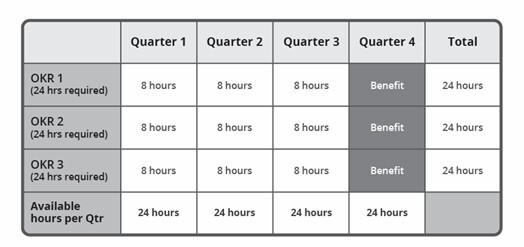
In Option 1, reflected in the following diagram, you split your available time equally between the three projects. Each quarter, you spend eight hours on Project A, eight hours on Project B, and eight hours on Project C.
On the surface, this feels balanced and fair. Everything is moving forward. Nothing is being neglected.
But here is the reality: after the first quarter, none of the projects are complete. After the second quarter, none are complete. Only at the end of the third quarter, are the projects complete.
That means you only start receiving the benefits of any of those projects in the fourth quarter.
For three full quarters, you have worked hard, but you have gained no tangible benefit from any of the initiatives. The business has not improved in a meaningful way. There is effort, but no value created.
This is exactly how many leadership teams operate. They spread themselves thin across multiple priorities, make slow progress on all of them, and then wonder why nothing seems to change.
Option 2 – Focusing Sequentially
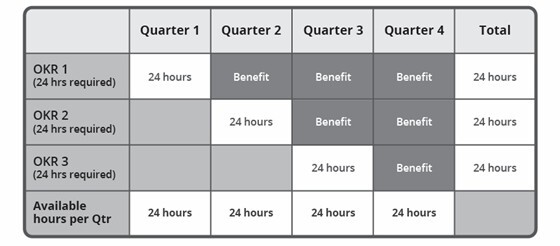
Option 2, reflected in the following diagram, you take a very different approach. Instead of splitting your time, you focus all twenty-four available hours in the first quarter on Project A. That project is completed in quarter one. In quarter two, you use your twenty-four hours to complete Project B. In quarter three, you complete Project C.
Now look at what happens.
You get the benefit of Project A in quarters two, three and four.
You get the benefit of Project B in quarters three and four.
You get the benefit of Project C in quarter four.
In other words, the business starts improving in quarter two, not quarter four. You get six quarters of benefit in Option 2 compared to three quarters of benefits in Option 1, a 100% improvement in output.
Nothing about this approach requires more effort. It simply requires better sequencing.
Finish What You Start
One of the most underestimated disciplines in business is completion. Half-finished initiatives create noise. Finished initiatives create productive output. When teams finish things, results improve and confidence grows.
This is why choosing fewer priorities is not about lowering ambition. It is about protecting execution.
When you focus on one or two things and finish them, the business changes. When you focus on six or seven and finish none, it doesn’t.
Choosing the Right Few
The natural next question is: how do you decide what to focus on?
This is where leadership judgment matters. You look at your strategy. You look at what is holding the business back. You look at where the greatest leverage lies. And you ask: “What is the most valuable next step? Which would have the biggest impact?”
It is not about what is important. All the things you would like to improve in your business are important! That is not the question. You need to choose the one that is most valuable and will have the biggest impact on moving your business forward.
Once you have chosen, you then break that priority into doable steps, allocate time to it deliberately, and protect that time fiercely.
The Bottom Line
When you focus, finish, and lock in gains, something powerful happens. The next quarter becomes easier. You are building on a stronger base. The organisation has more capability. The team has more confidence.
This is the flywheel effect. Each improvement makes the next improvement easier. Each gain creates capacity for the next gain. Over time, momentum builds.
That is strategic compounding.
Most businesses are not short of ideas. They are short of focus. If you want meaningful progress, you do not need more initiatives. You need better choices.


.png?width=352&name=HubSpot%20Blog%20Page%20Images%20(2).png)